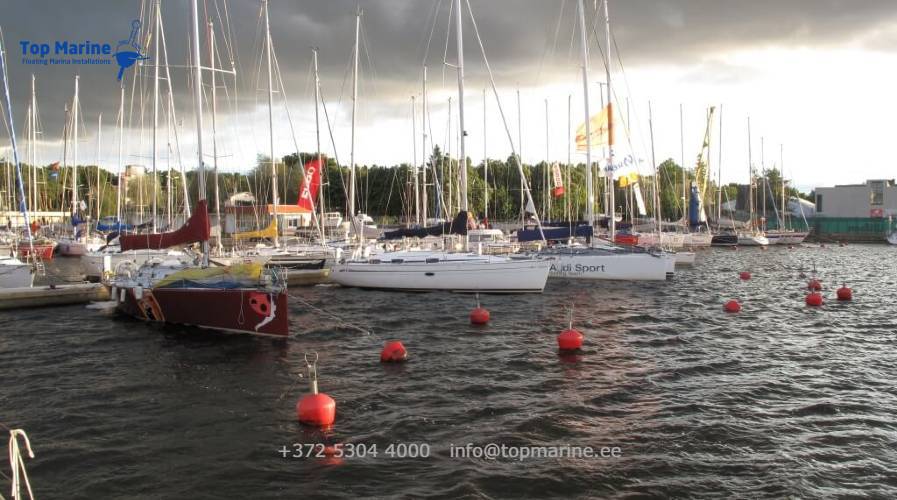
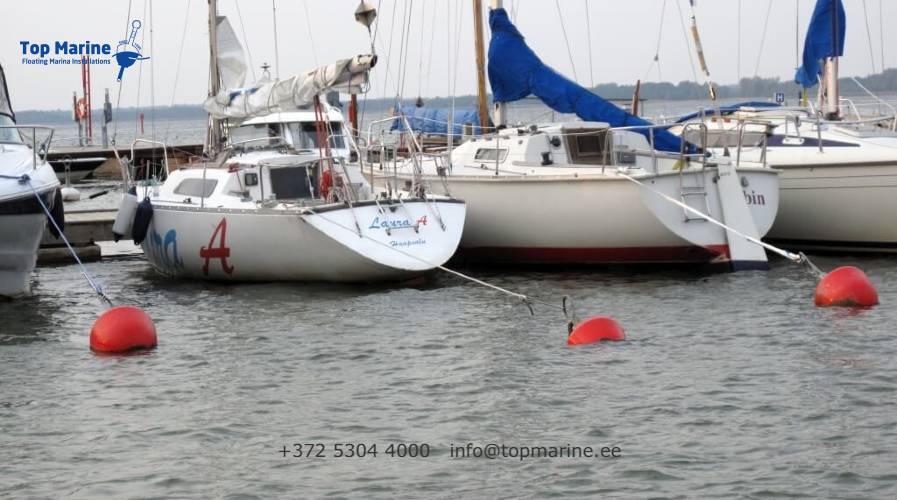
Mooring buoys provide a simple, cost-effective and reliable way to secure boats in marinas, harbours and private docks. They are easy to handle, require little maintenance and resist UV radiation and freezing conditions.
What is a mooring buoy?
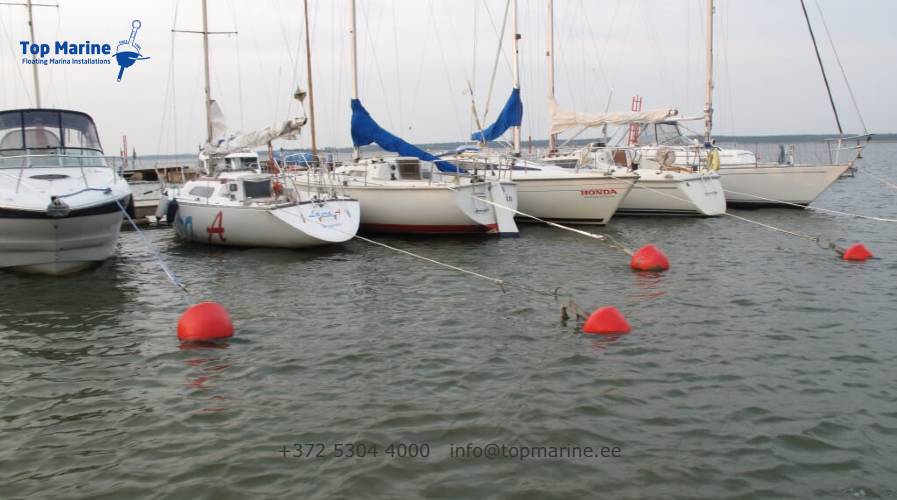
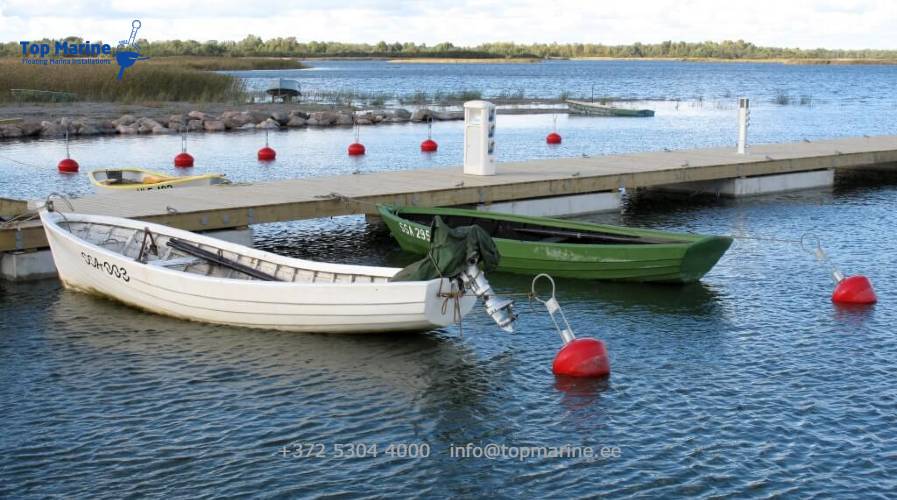
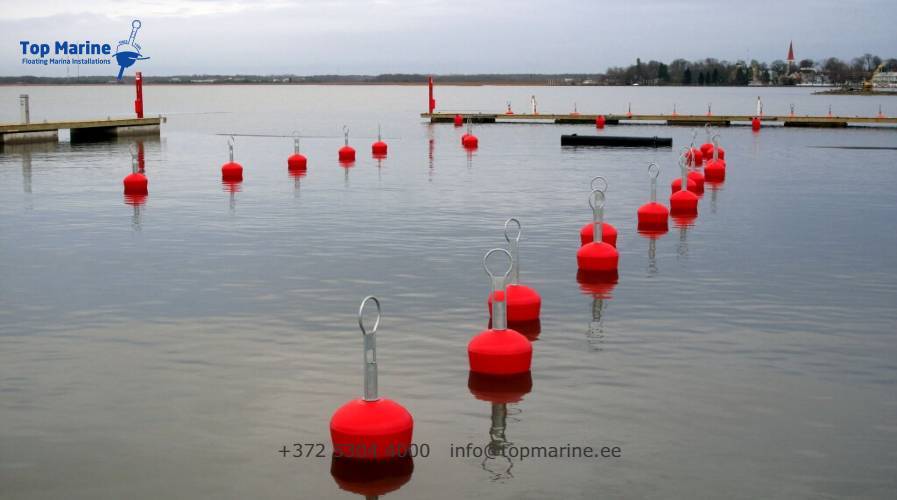
A mooring buoy is a floating buoy connected to an anchor or mooring system on the seabed. It provides a fixed mooring point for a boat, allowing the vessel to be secured without using a pontoon or fixed dock. Mooring buoys are commonly used in marinas, harbours, sheltered bays and private waterfront locations.
Compared with boat booms and mooring fingers, a mooring buoy is the simplest and most economical way to secure a boat. A boat boom provides better boat separation and more convenient mooring, while a mooring finger is the strongest, most stable and most comfortable solution. However, a mooring buoy is often the most practical choice when a simple mooring point is enough.
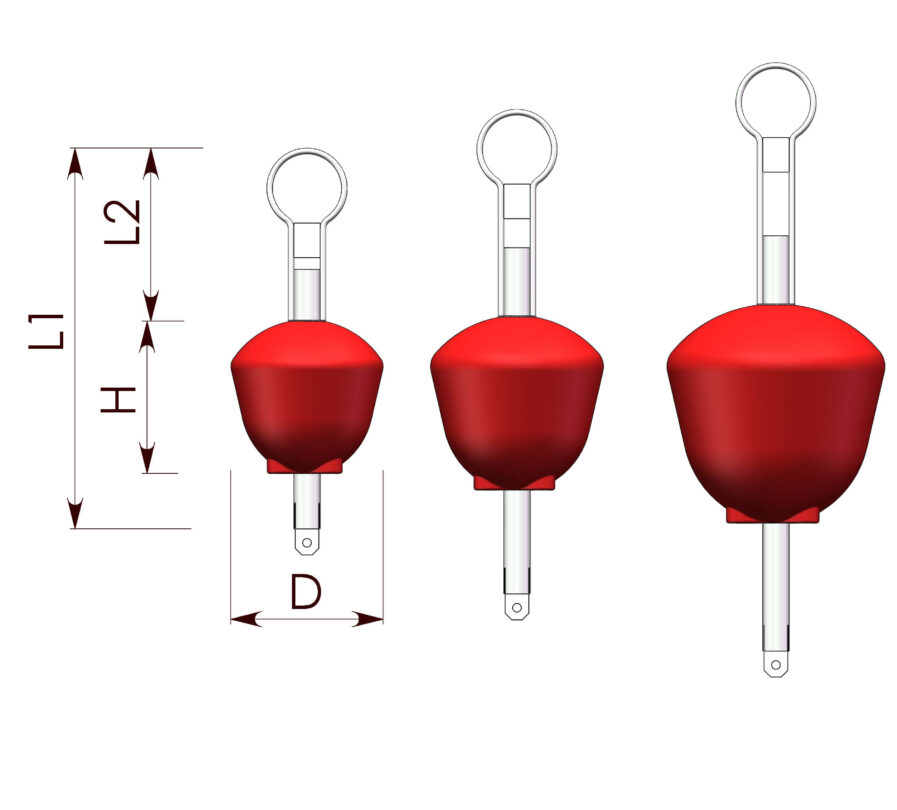
Each Top Marine mooring buoy consists of a hot-dip galvanised steel rod and an EPS-filled plastic float. In addition, we use a unique inner tube system that helps protect the EPS core and increases the service life of the buoy.
In standard buoys, water can enter the float over time. The EPS foam may then absorb part of that water, which reduces buoyancy. Our inner tube technology helps prevent water from reaching the EPS core, so the buoy maintains its performance and reliability for many years.
We supply mooring buoys in three standard sizes: 40 L, 60 L and 120 L.
- You can plan different pontoon and marina layouts in our web application and see the estimated cost of the project. The user manual is available here.
- If you work in marina design, harbour engineering or architecture, you can download mooring buoy models and other Top Marine product models from the ProdLib catalogue. You can also read the ProdLib guide here.
How to choose the right mooring buoy
When choosing a mooring buoy, start with the boat size, boat weight, water depth and seabed conditions. The right anchoring kit depends on the vessel and the location.
- As a general rule, the anchor weight depends on three main factors: the vessel’s displacement, sail area and seabed conditions.
- The mooring chain length should be the maximum water depth plus 1 m. In more exposed locations, the chain length should be approximately three times the water depth.
- The chain size should match the vessel weight. In addition, the shackle should always be one size larger than the chain. We also recommend locking the shackle bolts and checking them every spring.
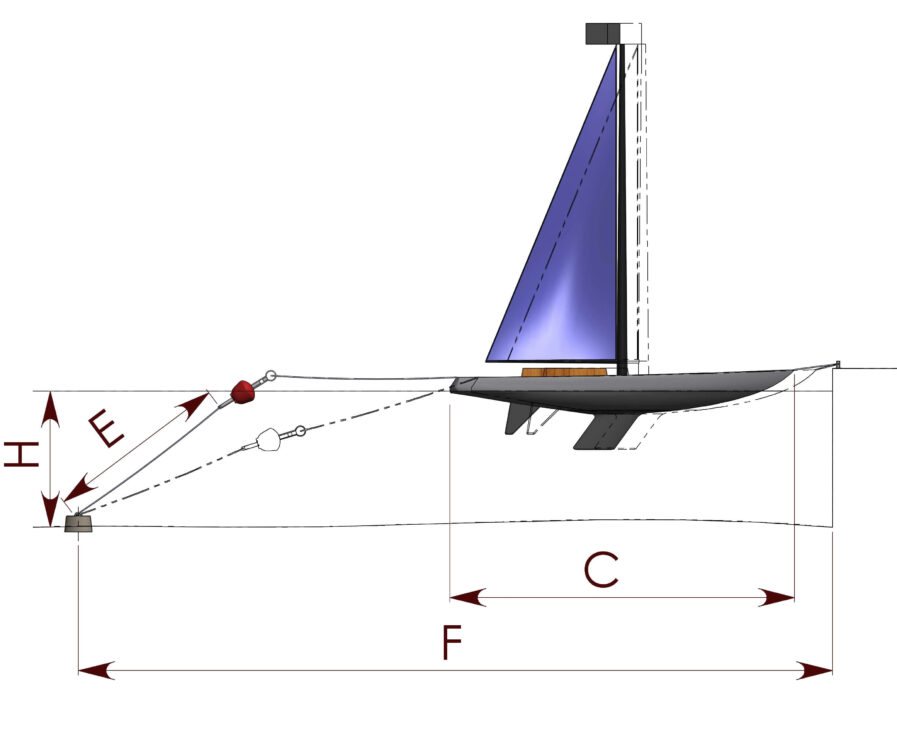
Mooring buoy selection table
| Sailing yacht dimensions | Anchoring kit | |||||
|---|---|---|---|---|---|---|
| Length (ft) | Length (m) | Width (m) | Weight (t) | Mooring buoy (L) | Anchor (kg) | Chain / shackle (mm) |
| 15 | 4.6 | 2.0 | 1.0 | 40 | 500 | 10 / 13 |
| 20 | 6.1 | 2.4 | 2.0 | 40 | 500 | 13 / 16 |
| 25 | 7.6 | 2.8 | 3.3 | 60 | 500 | 13 / 16 |
| 30 | 9.1 | 3.2 | 4.8 | 60 | 1000 | 16 / 20 |
| 35 | 10.7 | 3.6 | 6.5 | 120 | 1000 | 16 / 20 |
| 40 | 12.2 | 4.0 | 8.5 | 120 | 1000 | 16 / 20 |
| 45 | 13.7 | 4.4 | 10.8 | 120 | 2000 | 20 / 22 |